by Rodney Waterman
[The original version of this article was published in The Recorder, Journal of the Victorian Recorder Guild, No. 4, May 1986, pp. 29-33]
Rodney Waterman completed his Bachelor of Music degree (recorder performance, musicology) in 1979 at Melbourne University. He played recorder and lute in performances by the Victoria State Opera – Monteverdi’s L’Orfeo (1977) and Il ritorno d’Ulisse in patria (1980) – played in the Melbourne Organ and Harpsichord Festival, the Castlemaine Festival and other concerts in many states of Australia.
In 1983 Rodney was awarded an Australia Council grant to pursue studies with Kees Boeke in Italy and the Netherlands. While in Italy he gave several concerts and helped in the organisation of the Settimana Musicale di Pitigliano in 1984 and 1985. He also taught music for six months at the local primary school of Pitigliano in 1984. In this article Rodney gives an account of his musical and travel experiences during his two year sojourn in Europe, in particular, Italy.

I arrived in Italy in late November 1983, about a month before my recorder lessons with Kees Boeke were to begin. My partner Liz, who was completing university studies and work commitments in Melbourne, joined me three months later. Through an Australian friend, I was able to find a room in a delightful renaissance villa in San Domenico di Fiesole, a small village in the hills just outside Florence. The Tuscan landscape was very beautiful in late autumn, and the olive groves were conspicuous, contrasting with the Turkish oaks, the last trees to shed their rust-coloured leaves. The temperature dropped towards zero and there was light, unseasonable snowfall in the first few days of December 1983. Playing the recorder in a cold climate was something I would have to get used to.
I played my renaissance-style recorder inside the high-ceilinged stone-floored Villa San Michele, a lovely villa in San Domenico di Fiesole close to the Badia Fiesolana. I noticed a quality in the instrument that I had only occasionally been aware of before – a fleshy resonance which gave the instrument an added dimension in sound. I was to find that the acoustics of old buildings lend themselves favourably to the intimate qualities of old instruments and their music.
After some time in Siena, I took a bus to Pitigliano, arriving just before Christmas. I wasn’t prepared for the marvellous first sighting of the western face of this mediaeval village, precariously perched high up on a wide steep outcrop of volcanic rock (tufo). Pitigliano is situated about 120 km north of Rome and 150 km south of Florence in the rich agricultural belt between Viterbo and Grosseto. It had a population of 5000 and was primarily a grape and olive growing area well known for its Bianco di Pitigliano and Rosso di Pitigliano wine. Kees Boeke had been living in Pitigliano for some years, and he occasionally took students from Italy and elsewhere in Europe for private lessons in between his numerous European and international tours with various ensembles.
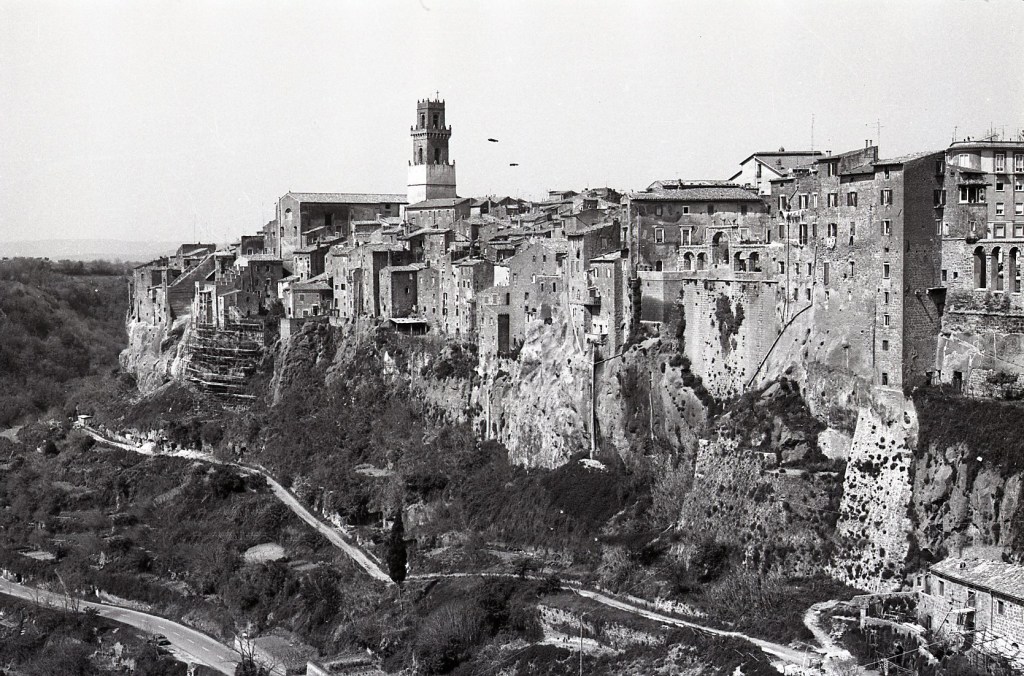
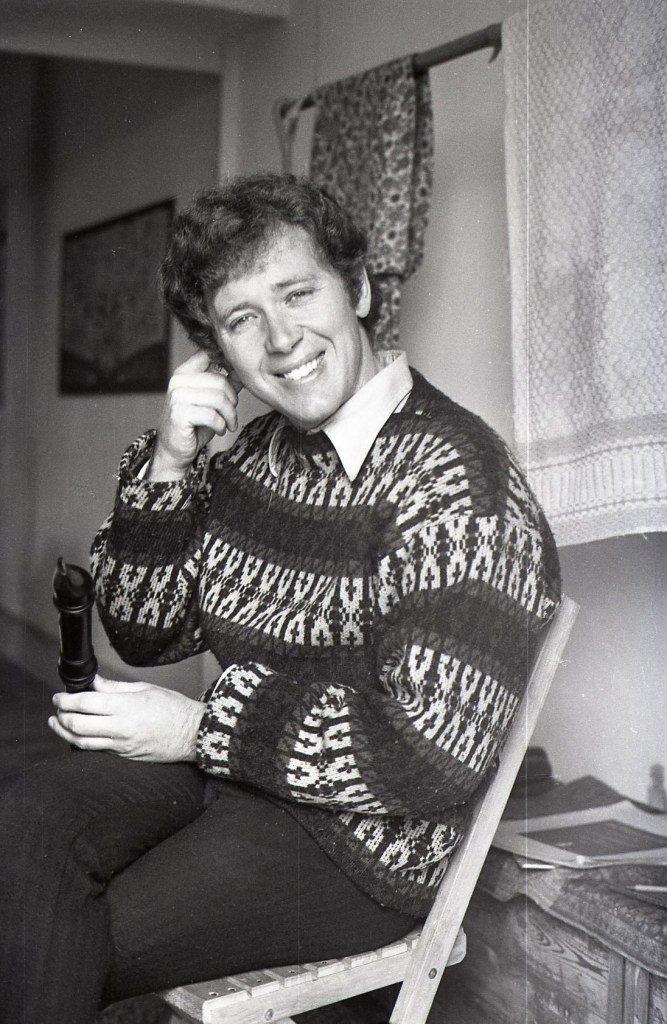
Originally, I had planned to take one private lesson with Kees every second day for 48 days, but this proved impractical. I found that I needed at least a week to really absorb what I had learnt, so we decided to extend the program over a more flexible period of six months – a period which included Kees’ tour of Australia with Sour Cream and a series of concerts in Amsterdam with his ensemble, Quadro Hotteterre. The breaks gave me plenty of time to practice and review my lessons, which began on Christmas Day 1983 and finished in June 1984. It was an exciting time of intensive study.
I began the first lesson nervously with Bassano’s Ricercata Quinta, an excellent choice as it quickly revealed flaws in my general technique as only a piece like that can, and the subsequent 24 lessons were planned based on that lesson as Kees was able to pinpoint my areas of weakness almost immediately.
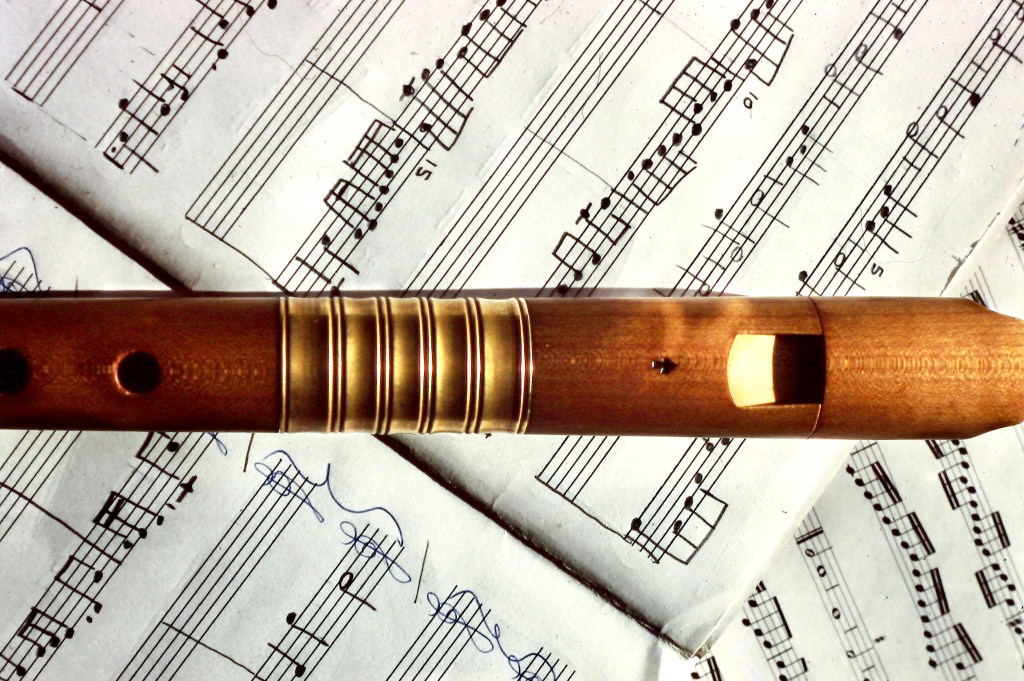
My hand position was changed to a more comfortable and relaxing grip which made an immediate difference to my playing. My right hand had been too crabbed over the holes and by flattening my fingers into a more natural lying position, finger movement became more effective and effortless. My left hand was adjusted accordingly. Seven lessons were specifically on technique related to pieces I had chosen, and during these I spent considerable time on breathing techniques such as open and closed breathing, even breath pressure exercises (in particular for chromatic scales) and the active and passive processes involved in diaphragmatic breathing. We spent time on tonguing too, in particular in diminution. We looked at the relationship between articulation and throat tension and ways of reducing tension while maintaining fluent articulation.
We analysed a Bach flute sonata and a suite by Hotteterre. The last five lessons were spent on a detailed study of Luis Andriesson’s Sweet, a difficult piece with complex rhythms, wide pitch and dynamic variations. In the final lesson we worked through scores by Berio, Shinohara and Ishii, and some pieces composed by Kees himself.
During that period, we covered a wide spectrum of technical analysis and stylistic consideration. In the end I felt that I would need many years to fully absorb and incorporate all the information arising from the lessons. I had certainly had the opportunity to ask all the questions I had ever wanted to ask about the recorder and its music.
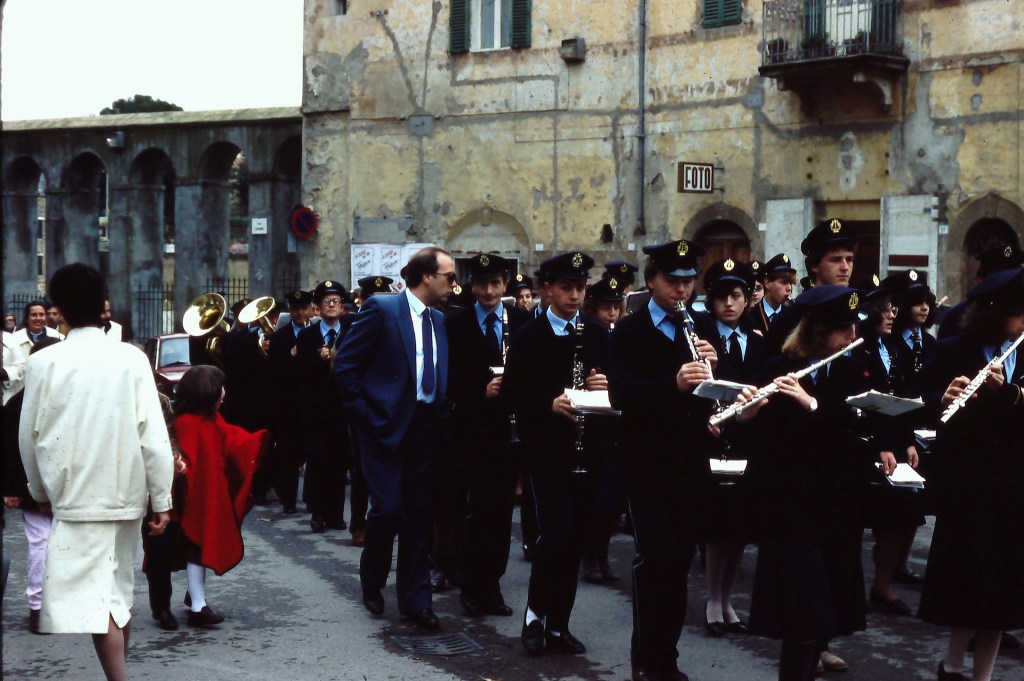
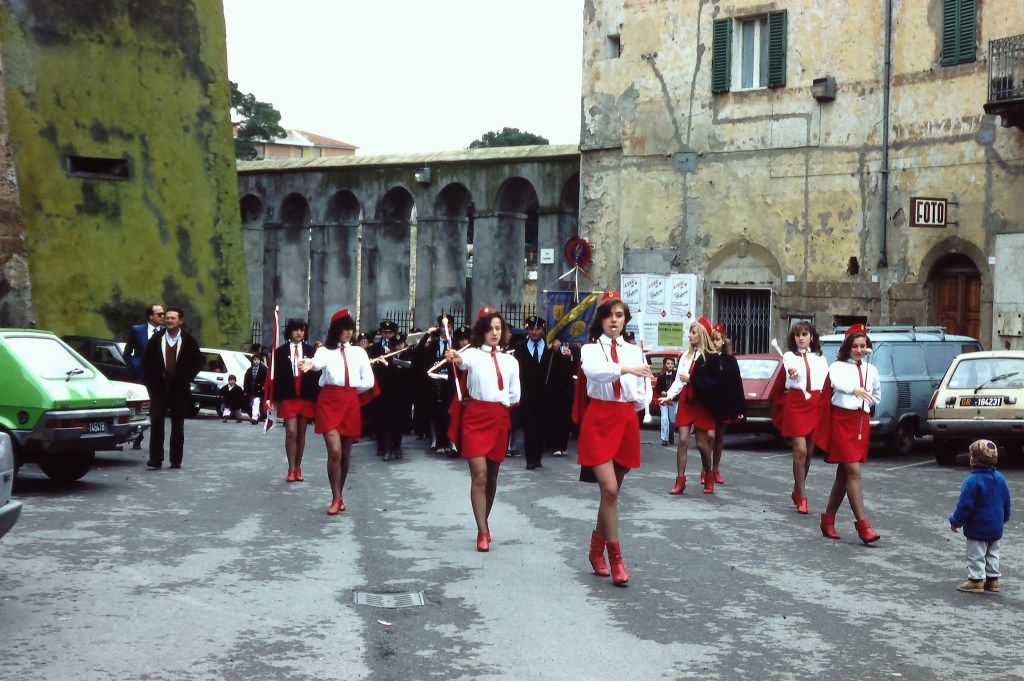
In the meantime, I became involved in the life of the village of Pitigliano. My introduction to the villagers came unexpectedly early when I was asked to perform a musical item at the annual concert of La Banda di Pitigliano in early January 1984. The Banda (a typical brass and wind band that forms the major hub of so many Italian villages) performed in the local Teatro on a stage appropriately adorned with ferns and large leaves painted red or silver. In front of the stage was an ornamental fountain made of papier-mâché which spouted red imitation wine, and the electric generator which ran the fountain was responsible for a string of power failures throughout the evening. It was quite an experience to perform my little Istampitta amongst the spirited and brassy renditions of Il Padrino (The Godfather), The Radetzki March, El Capitan, Largo dei Cigni (Swan Lake), and Brazil. My item was enthusiastically received and at the interval I joined the band in a few celebratory swigs of whisky, something which may have adversely affected the band’s intonation in the second half, particularly during passages of Lago dei Cigni. Kees and his then partner, ‘cellist Caroline Boersma, also performed movements from a Teleman suite.
[Click on images above to see larger]
In February, I travelled to Amsterdam to continue my lessons with Kees, who was teaching at the Sweelinck Conservatory as well as performing in concerts. I remember the weather as mainly grey and cold. The canals began to freeze over in the first week, but subsequently it warmed up to somewhere between zero and 3°. I became very fond of the hazy yellow and orange sunsets which somehow transcended the prevailing greyness of the average day. I found accommodation on a houseboat not far from the centrum.
At the Klein Zaal of the Concertgebouw, I heard the Amsterdam Loeki Stardust Quartet. Their wide and popular repertoire and versatility in many styles from jazz and contemporary, to baroque and renaissance, left no doubt that the recorder quartet had many unexplored possibilities. The program included a marvellous virtuouso mediaeval estampi adapted for quartet, a fluid rendering of Isaac’s Ach, weiblich Art, a Bach Preludium and Fuga, the by now Loeki trademark Pink Panther and several modern pieces composed by members of the group.
I also attended the group classes (Blok) of Walter Van Hauwe and Kees at Sweelinck Conservatorium. In a student concert at the end of the teaching blok, all participants presented a piece. Apart from Sollima’s Evoluzione No. 3, performed by an Italian student, the most exciting work was Matsunaga’s Reeds, Twigs, Winds and …, performed by a Dutch student, Eva Boon, and a New Zealand marimba player. Much of the piece was freely improvised around skeleton suggestions made by the composer. The moods and exotic textural sound colours of recorders (and various whistle flutes, some with rice paper placed in the fipple) and marimba were at once evocative, brilliant, sombre and deliciously eastern in flavour. The piece required a theatrical commitment from the two players, and this was ably done with a fine sense of controlled movement and gesture. [I was so inspired by this performance that I composed a few pieces for Eva. I was thrilled to later learn that she performed one of those – Beach-washed stone (later renamed Pebbles) – with two other students (Sébastien Marq and another) at the Sweelinck Conservatorium ‘voorspeelavond of the Blok’ on May 18, 1984].
There was humour, and sometimes drama, as each student in the teaching group went through their prepared pieces in the Blok master classes. I recall Walter van Hauwe’s comment to a student, who rocked and swayed excessively as he made his way through a ricercar of Ortiz: “You’re a romantic person, and as soon as you play that thing (i.e. the recorder), you’re lost!”. And on another occasion, he asked the student audience to react with a ‘thumbs up’ or ‘thumbs down’ to an individual performance. This was a little too ‘gladiatorial’ for me. But the students generally appeared to thrive on the energy, vitality and challenge of their interactions with Walter and Kees. I enjoyed meeting, and hearing perform, so many keen recorder students from around the world.
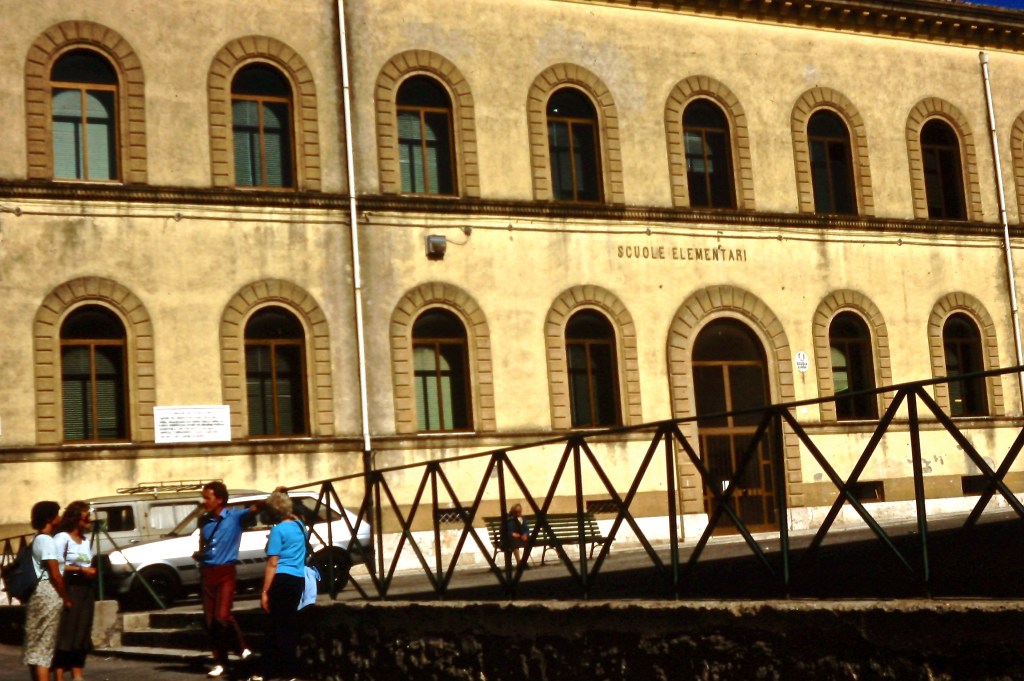
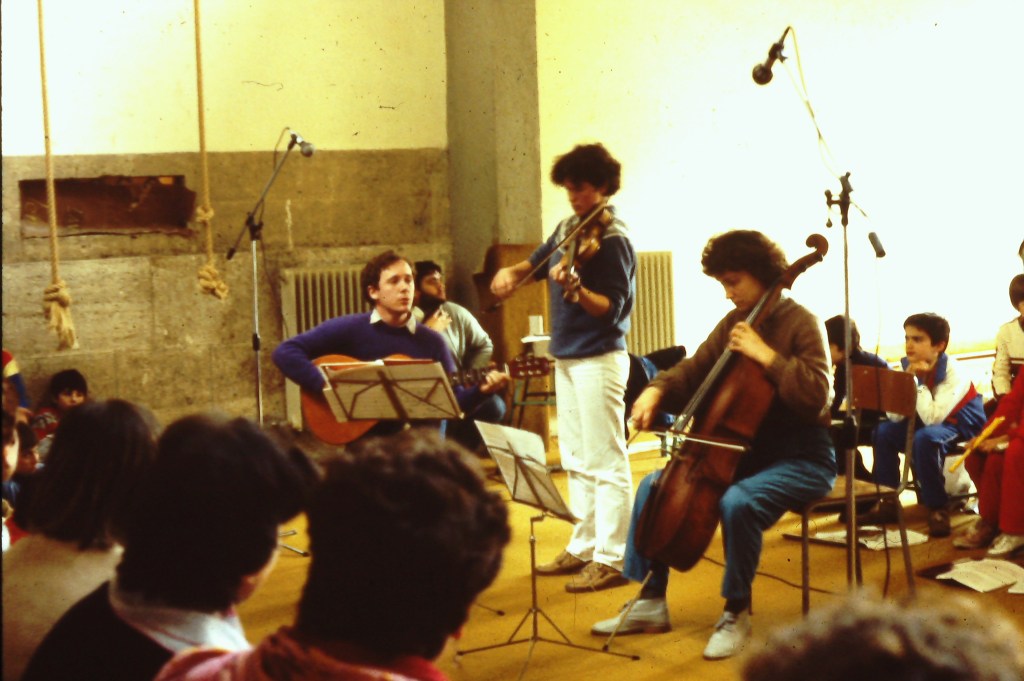
Back in Italy in March my lessons were underway again and I began teaching recorder at the local scuole elementari di Pitigliano (Pitigliano Primary). There was no music teacher employed in the state school system in the village and the school was happy to have someone there, even though I was technically ineligible for a work permit. Although I taught during school hours, the parents paid me a monthly fee in advance in a private agreement. Who knows, I was probably teaching the son or daughter of the local carabinieri!
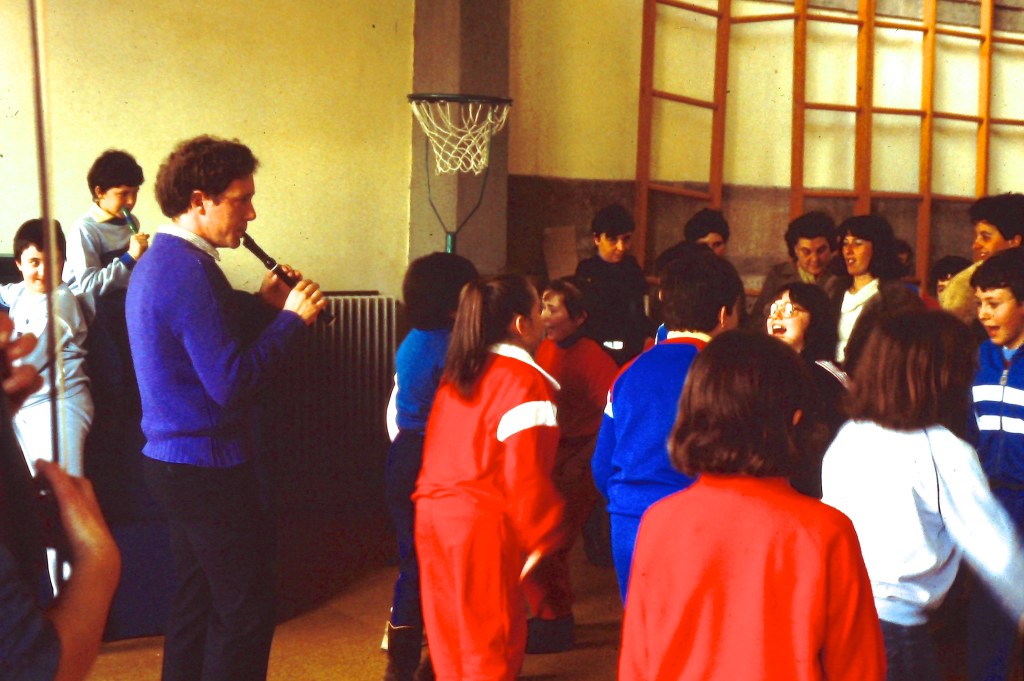
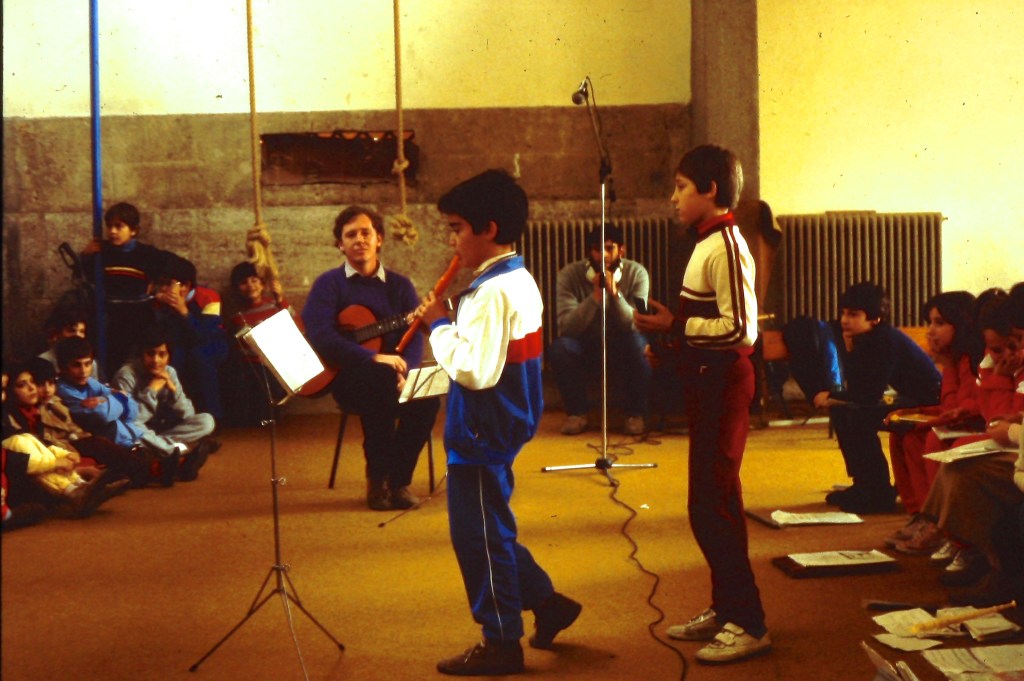
The children were beginners, and we made a deal that while I taught them recorder, they would help me to improve my Italian, an excellent way to learn a language quickly. It was a lot of fun, and for the children, teachers and parents, it was a gala occasion when the kids gave concerts at the end of each term, the second being recorded by Radiopitiglianuno, the local community radio station, and broadcast on Christmas Day 1984. This concert wound up with the Latin verse of O Come All Ye Faithful, after which the children broke spontaneously into the Heel and Toe Polka … “tacco, punto, tacco, punto, uno, due, tre, quattro” … all dancing and having a ball. My partner Liz (violin) and Caroline Boersma (‘cello) joined in our little ‘orchestra’ to accompany the students.
[Click on images above to see larger]
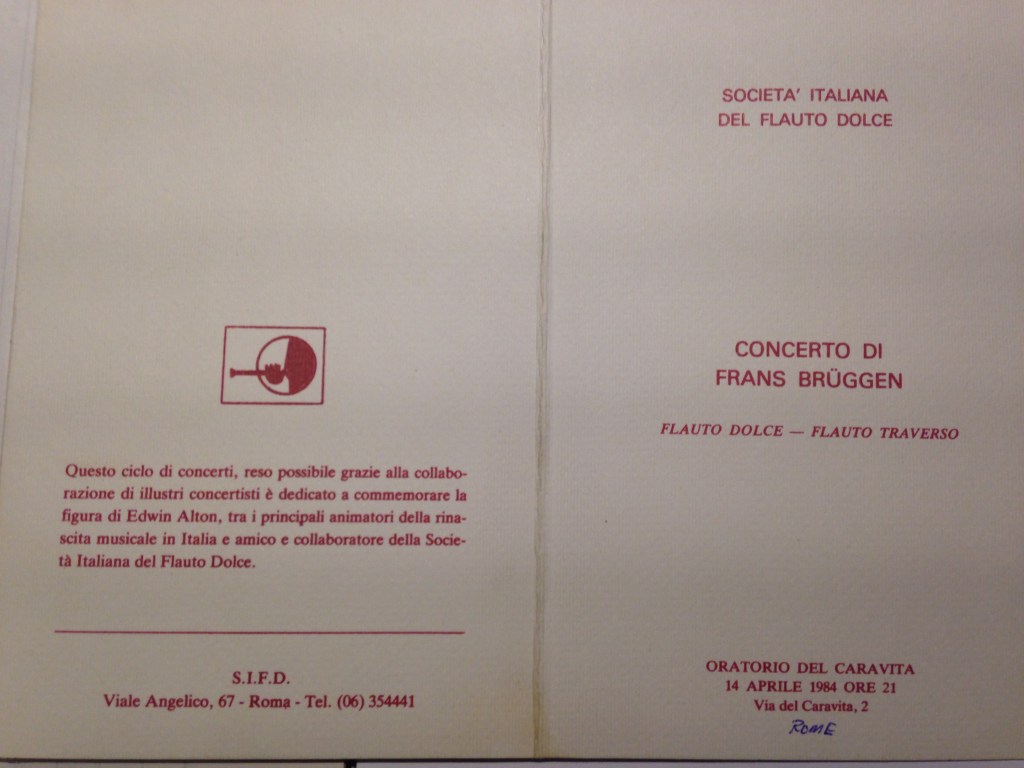
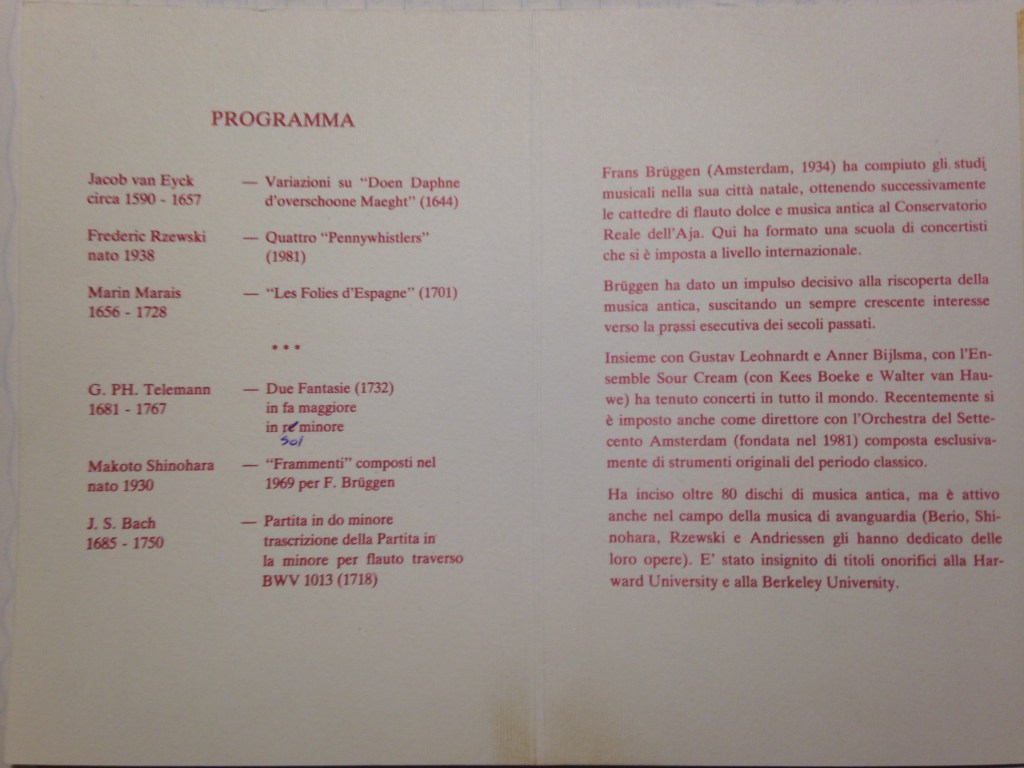
In April 1984 I heard Frans Brüggen perform in the Oratorio Del Caravita in Rome. It was organised by the Societa Italiana Del Flauto Dolce (Italian Recorder Society). The society organised several concerts each year, published new and old recorder music, ran a summer school each year in Urbino and published a rather academic periodical magazine. Unfortunately, the Brüggen concert was marred by traffic noise and a persistent burglar alarm sounding from without, but it was still a treat to hear him play. He had a commanding stage presence, dressed in a dark suit and white shirt, with grey hair and long, agile fingers. I was particularly impressed by his range of breathing techniques, from the most subtle to the deliberately rough and aggressive. I liked Frederic Rzewski’s Four Pennywhistlers and Shinohara’s Fragments. The Rzewski piece involved considerable interchange of recorders. He also played works by Bach, van Eyck, Marais and Telemann.
[Click on images above to see larger]
It was about this time that I heard an interesting recording by a Dutch player and composer, Laurens Tan. He apparently specialised in the bass recorder. He used unusual blowing and tonguing techniques that gave a very colourful, ‘primal’ character to his music. It had a repetitive and primitive melodic thread, and with stylistic consistency, he explored a dimension of the recorder into which few had ventured.
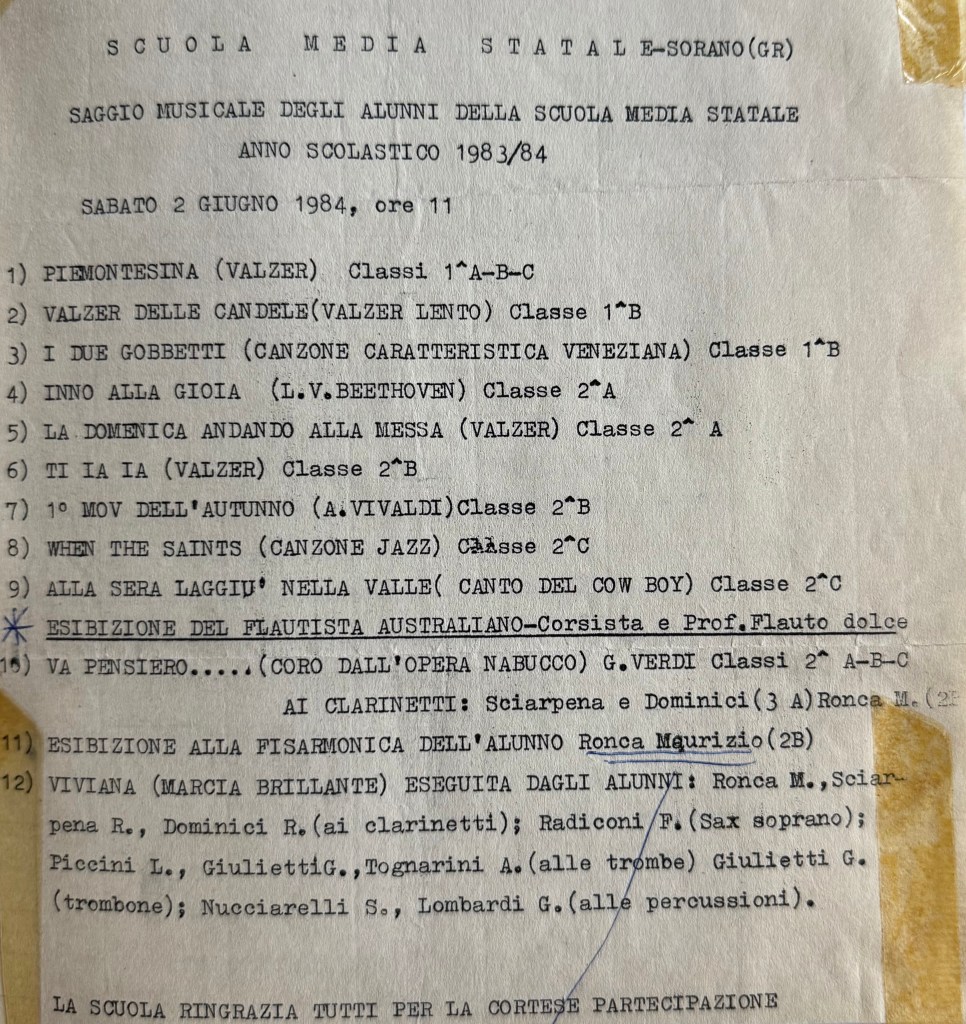
On June 2, 1984, the music teacher at the nearby scuola media statale Sorano (Years 7-9) invited me to perform in an end of term student concert. They were intrigued by the van Eyck piece I played for them, but the virtuosity of my playing was inferior to a 12-year-old student, Maurizio Ronca, who stunned everyone with his nimble-fingered fisharmonica (piano accordion) solo performance.
During both the summers of 1984 and 1985 spent in Italy, Liz and I were fortunate to be involved in the organisation of the Setttimana Musicale (Week of Music) in Pitigliano. Kees and other residents inaugurated the first Settimana in 1983 which concentrated on the music of Telemann. 1984 was the year of Henry Purcell, and in 1985, Benedetto Marcello. Players of recorders, gamba, Baroque strings and harpsichord came from all over Europe and some from as far away as Japan and America to attend the course. In that week Pitigliano lived music intensely, with workshops, masterclasses, concerts and the after-concert activities.
The main teacher for recorder in 1984 was Dutch player Han Tol, who taught widely in Europe and performed with the Amsterdam ensemble, La Fontegara. He was a fine player and an enthusiastic teacher. He played flute parts in Telemann’s Paris Quartets and Bach’s Brandenburg No. 5 very convincingly on the Voice Flute. There were also many excellent students of recorder in the course. I remember a French player, Christine Pollak, performing a magic rendition of a J.S. Bach ‘cello suite transcription.
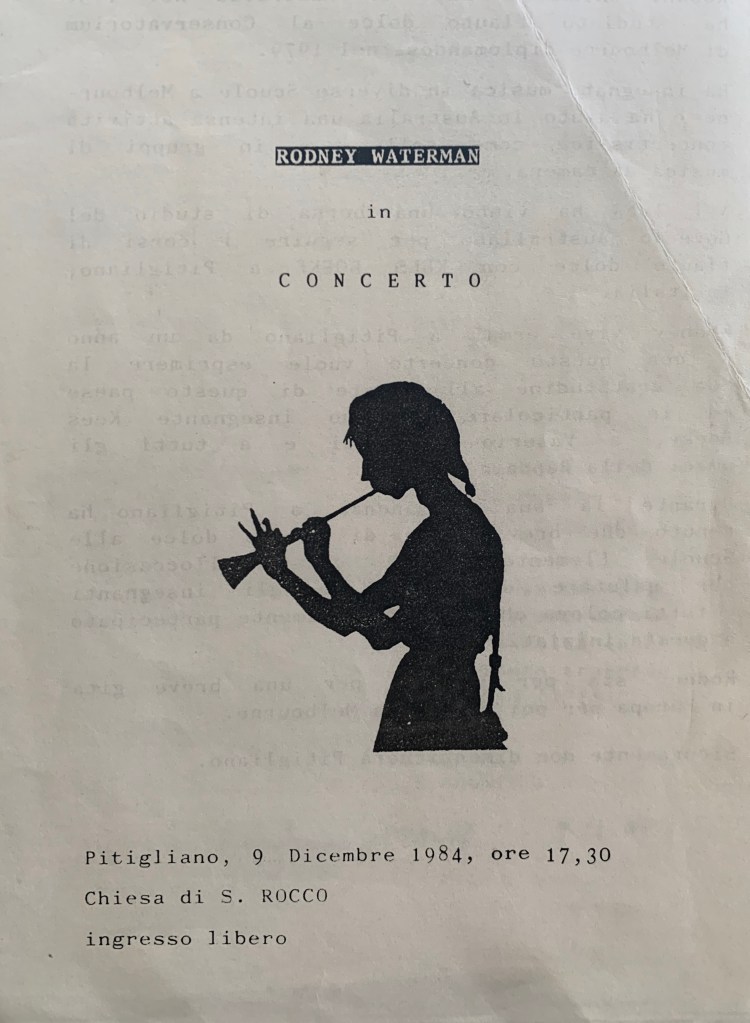
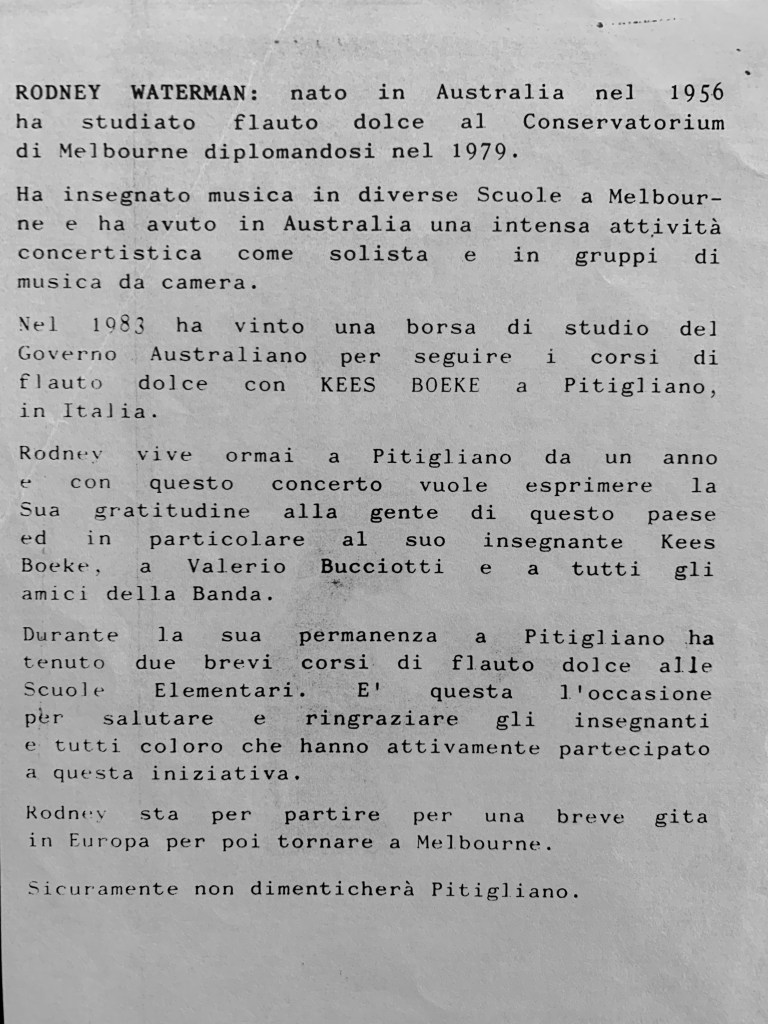
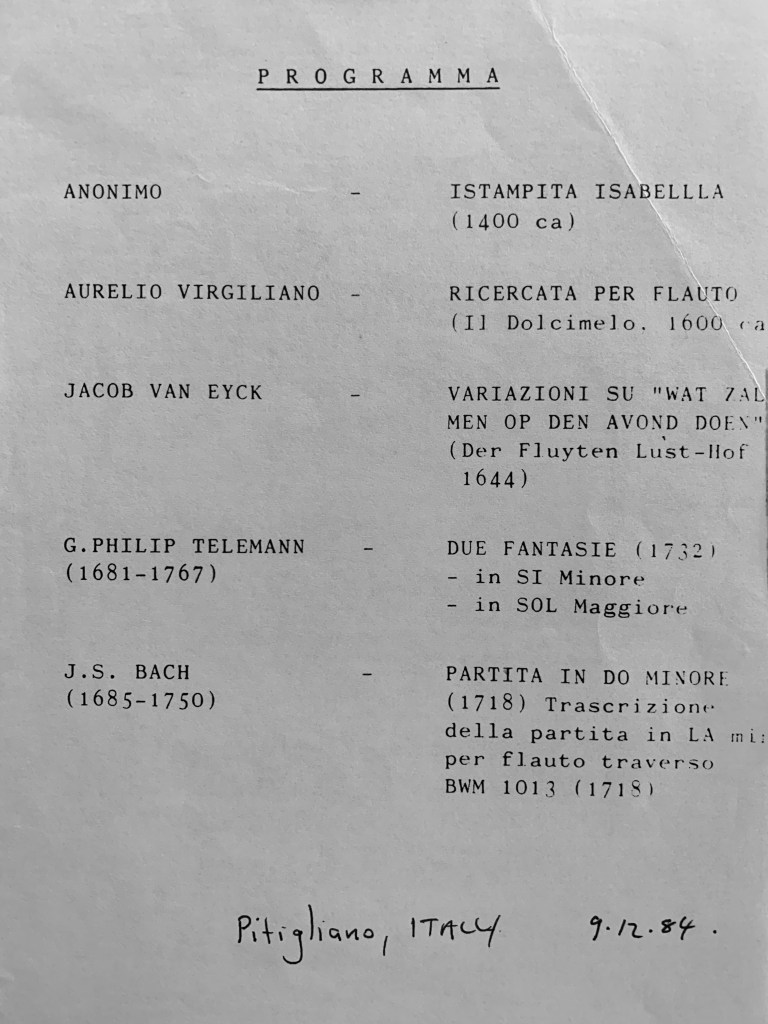
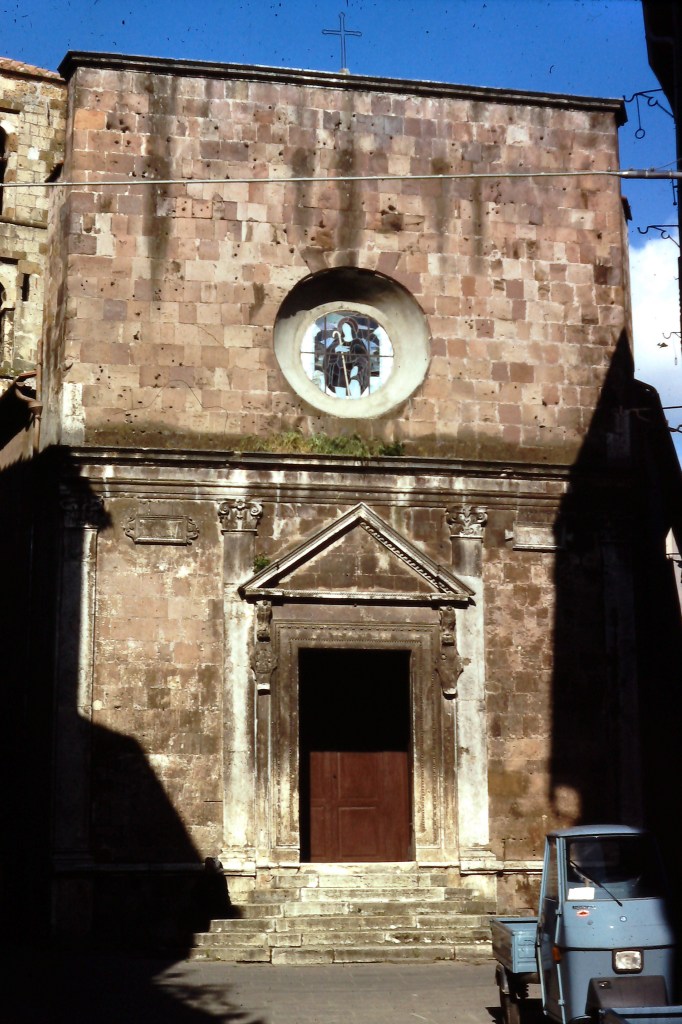
In December I coached some baroque ensembles at a private music school in Rome, and for the last musical activity at the end of my first year in Pitigliano (1984) I performed a public solo recital in the little church of San Rocco. The acoustics were a dream for the recorder, my only problem being that it was 3°C outside the church, and not much warmer inside.
[Click on images above to see larger]
For the first four months of 1985, Liz and I lived in Paris, unfortunately during the coldest winter since 1944. Liz worked as an au pair, and I found a job teaching Italian to some American students, and other than concert going, my musical experiences were confined to busking in the Paris Metro. I devised theatrical techniques for earning good money in the right place at the right time. I would personally like to thank the nun and the lady in the mink coat with the poodle, who respectively dropped a packet of biscuits and a 50 franc note into my hat. I also enjoyed busking occasionally in the forecourt of Notre-Dame Cathedral. I read Victor Hugo’s The Hunchback of Notre-Dame in a small park in full sight of the Cathedral.
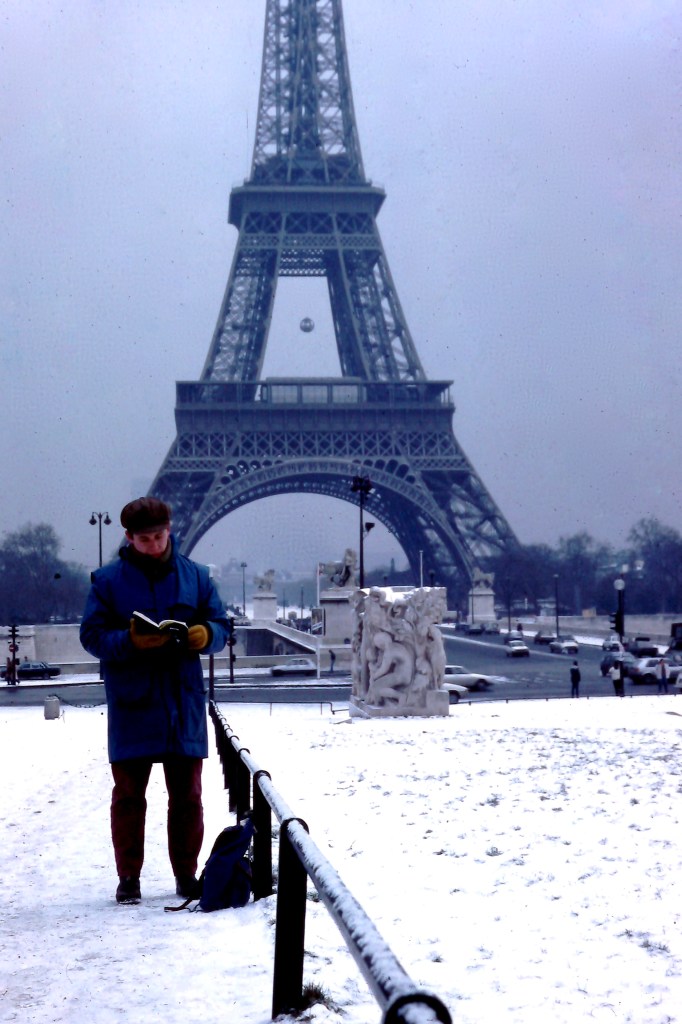
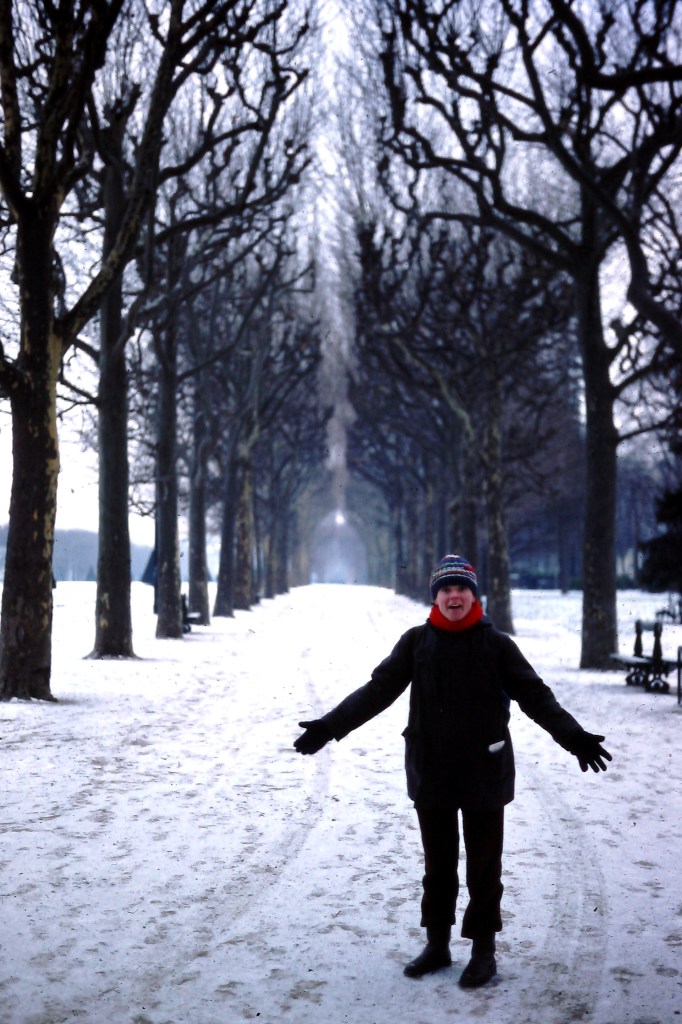
[Click on images above to see larger]
We went to quite a few festivals featuring the work of French contemporary composers, notably Pierre Boulez. We took advantage of the many cultural events easily accessible at the Pompidou Centre and went to concerts at the Salle Pleyel. We had booked into a recital by Dietrich Fischer-Dieskau at the Salle on February 16, but unfortunately, he was ill and cancelled. On March 5 we attended an Amnesty International concert hosted by Radio France with Christa Ludwig (mezzo soprano) and Youri Egorov (piano).
I dropped in at the Paris Greenpeace headquarters and took on a few small projects as a volunteer.
We heard Hespèrion XX perform 16th century Spanish music in the church of St Germain L’Auxerrois, close to the Louvre. This was part of an extensive series of concerts in the IVe Festival des instruments anciens, most of which we couldn’t afford to attend unless the busking was good. It was well worth the effort to hear Hespèrion XX, especially the sensuous voice of Montserrat Figueras, often matched in tenderness by the liquid cornetto playing of Bruce Dickey and the sinuous arabesques of Jordi Savall’s gamba.
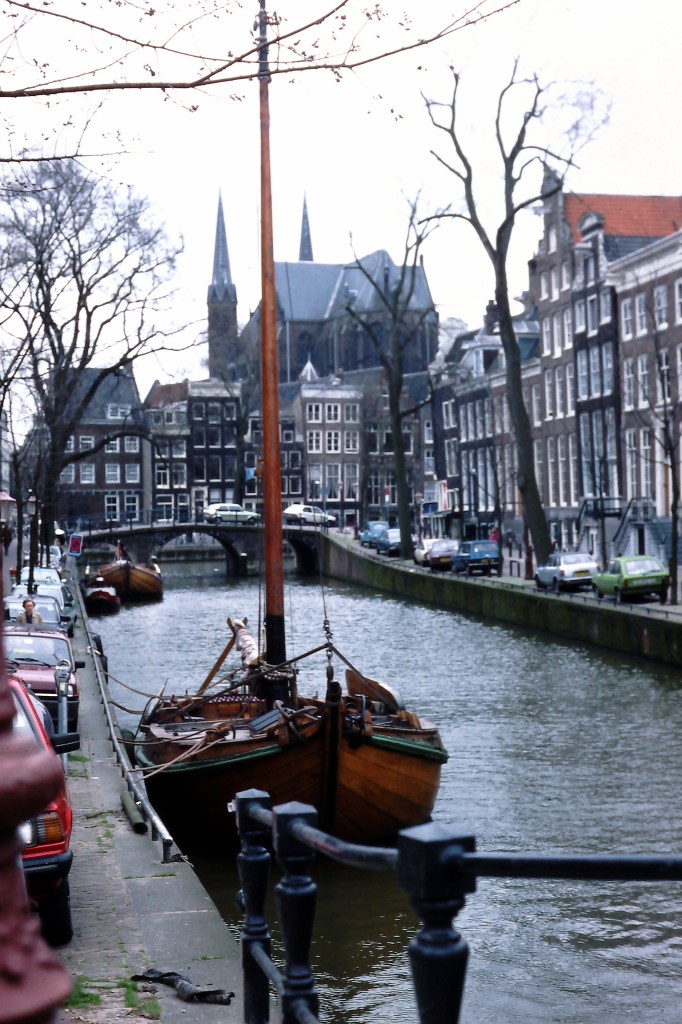
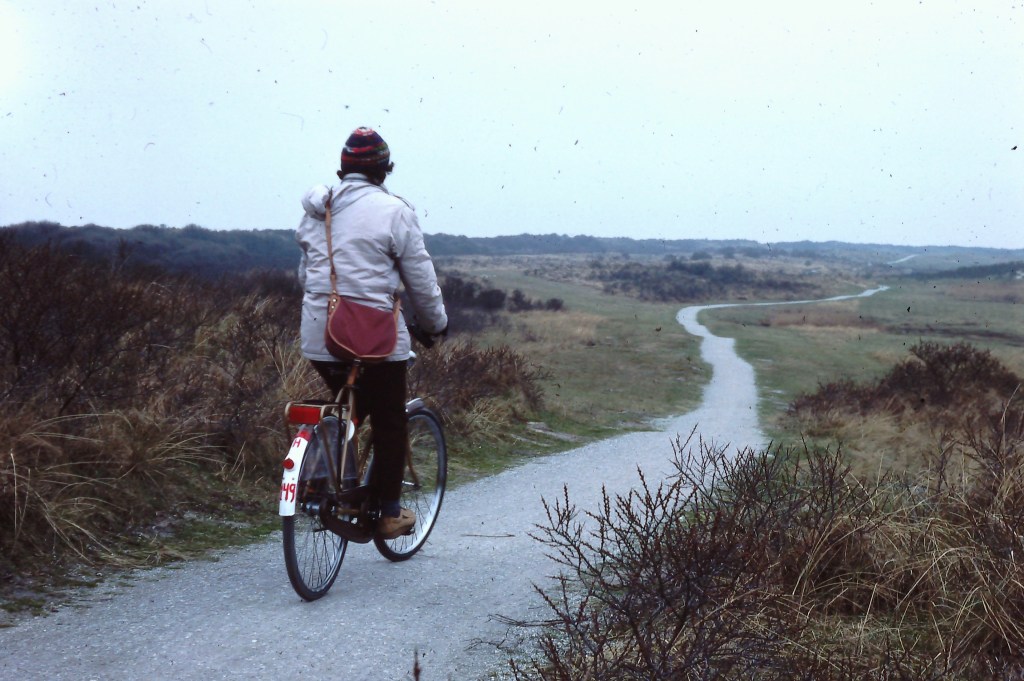
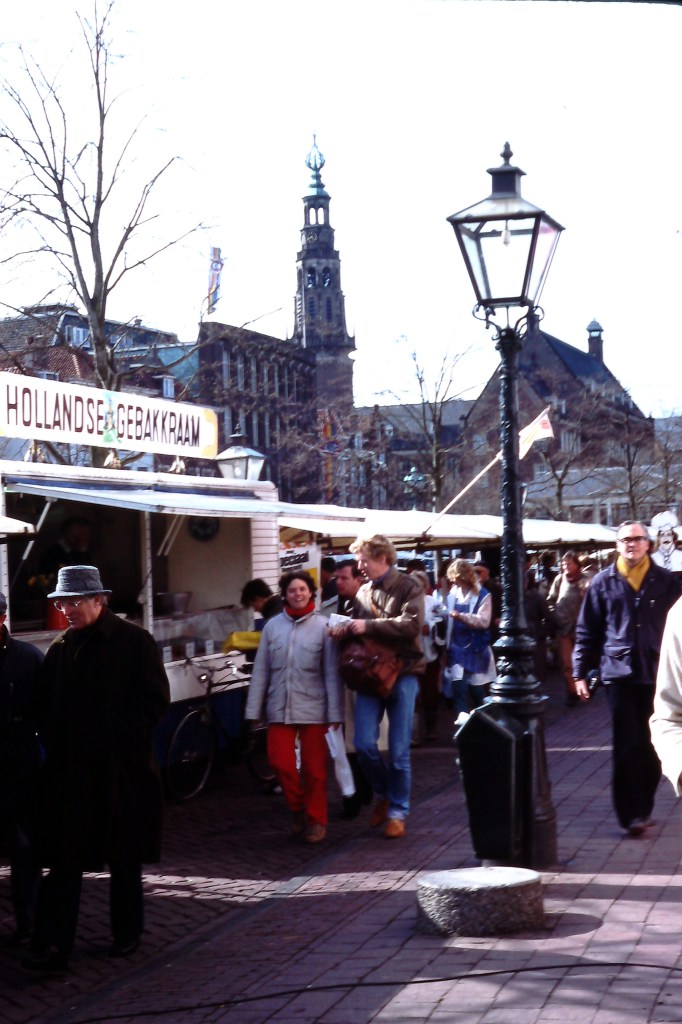
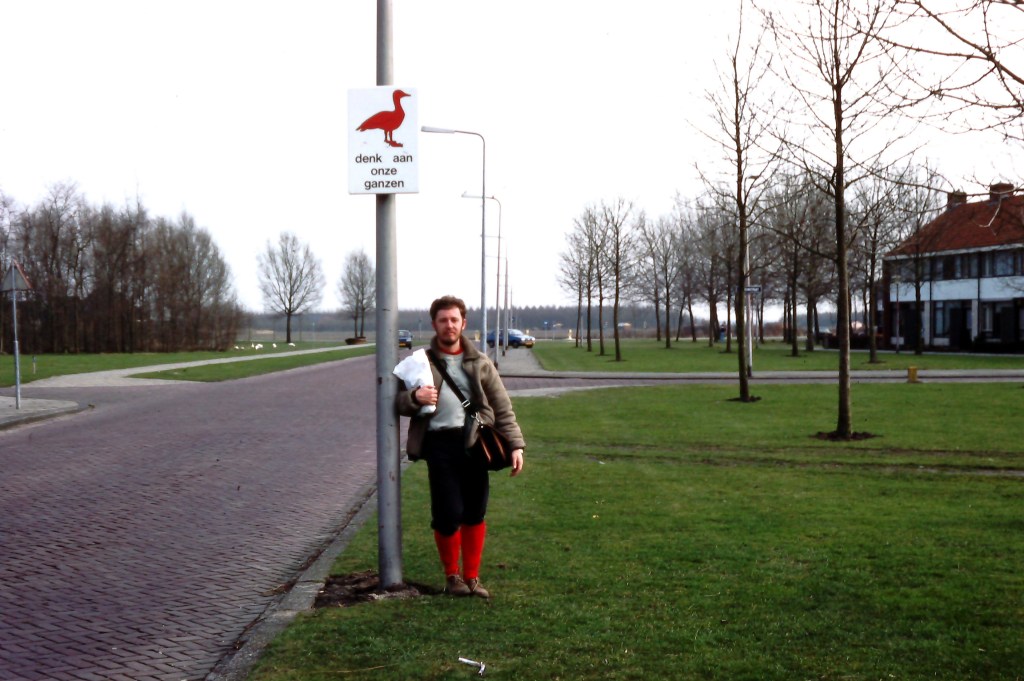
In late March/early April 1985 we took a train from Paris to spend 3 weeks in Amsterdam. We visited friends there and also in Swifterbant, Leiden, Delft and Groningen. We camped a few nights at the isle of Schiermonnikoog, a wonderful natural conservation reserve with lots of birdlife. On April 4 we cycled from Swifterbant to the Boswachterij Roggebolzand (forest) and back. In Delft, as in many Dutch cities, we enjoyed many walks and the ringing of the carillon.
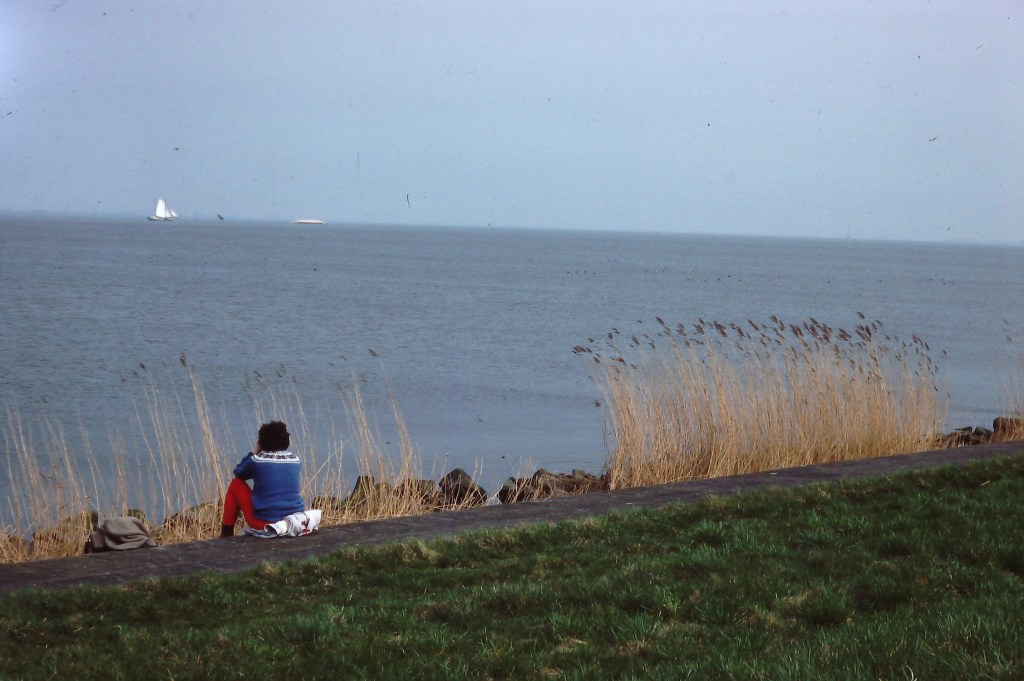
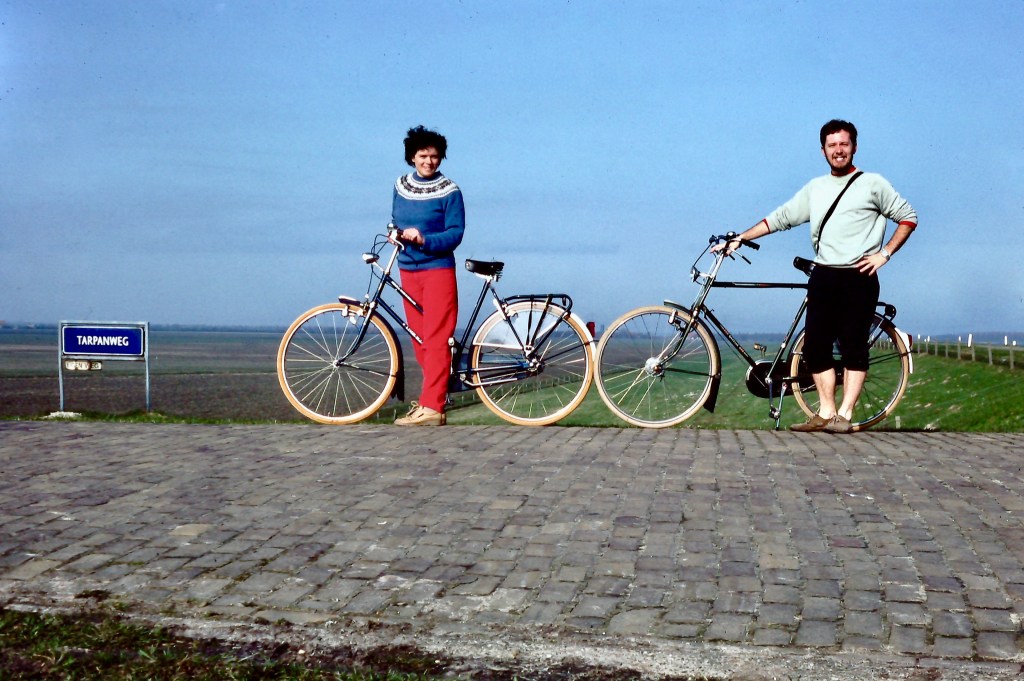
[Click on images above to see larger/fully]
Back in Paris In May, we heard the Orchestra of the 18th Century conducted by Brüggen. It was a revelation to experience the crisp fiery articulations of spirited players transform Mozart (Symphony Nos. 35 and 40, Clarinet Concerto on basset horn) from the common ‘Heinz Soup’ variety (i.e. you can eat it with a fork!) into a transparent dynamic sound.
On May 11 we travelled to Essone, Île-de-France region, to attend a world music festival, Ris-Orangis, featuring La Grande Bleue, Lo Jai, Louis César Ewande, Choeur Féminin de Bistritsa, Polyphonies Sardes, Quilapayun and the Chieftains. The latter was a crowd favourite, especially when a young Michael Flatley (26 yrs old, pre-Riverdance) joined the Chieftains on stage in a surprise appearance with an exciting and athletic Irish dance set. The audience went wild!
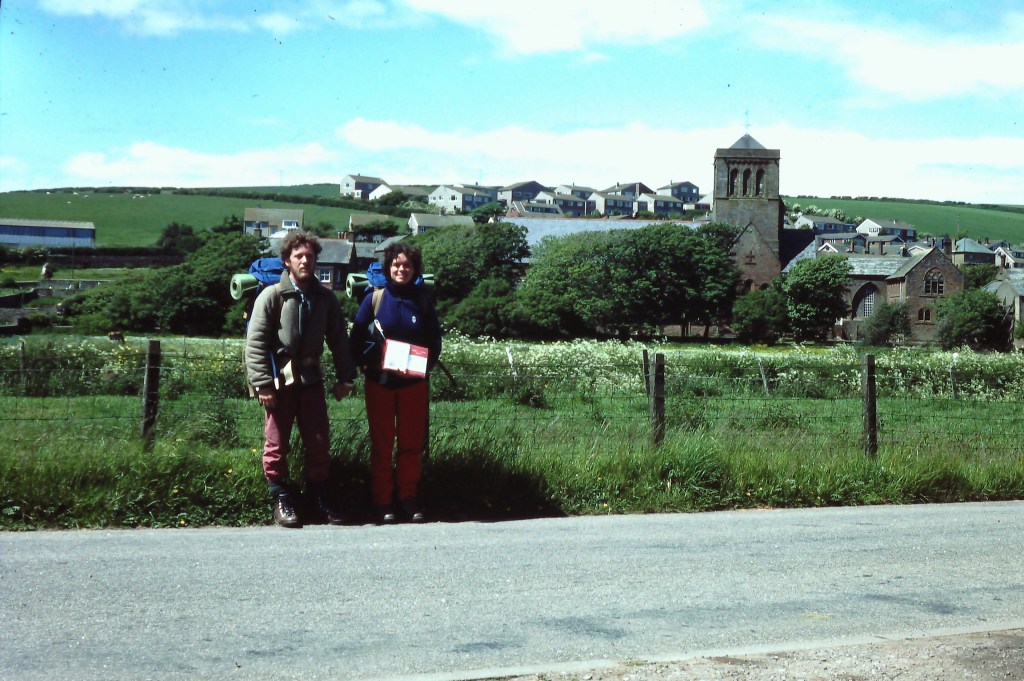
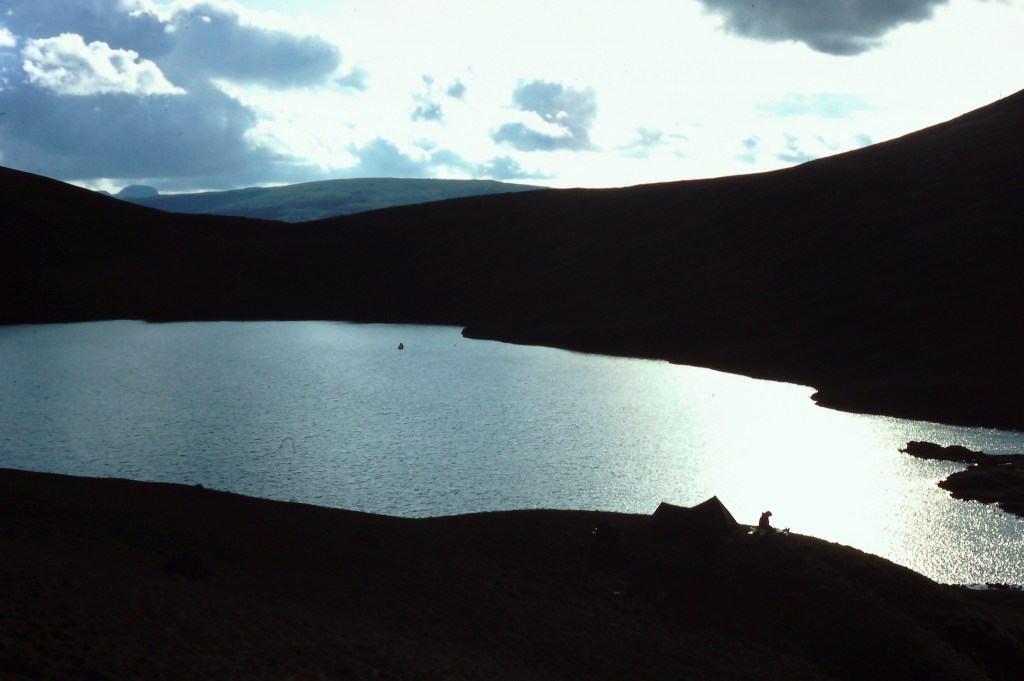
After Paris, we spent two months in England, where I have little to report on music other than the lively Morris dancing at Grasmere (Wordsworth’s hometown) which we encountered in June 1985 on a fabulous 200 mile, 18-day walk across England from St Bees on the west coast to Robin Hood’s Bay on the east coast — known as the Coast to Coast walk.
[Click on images above to see larger]
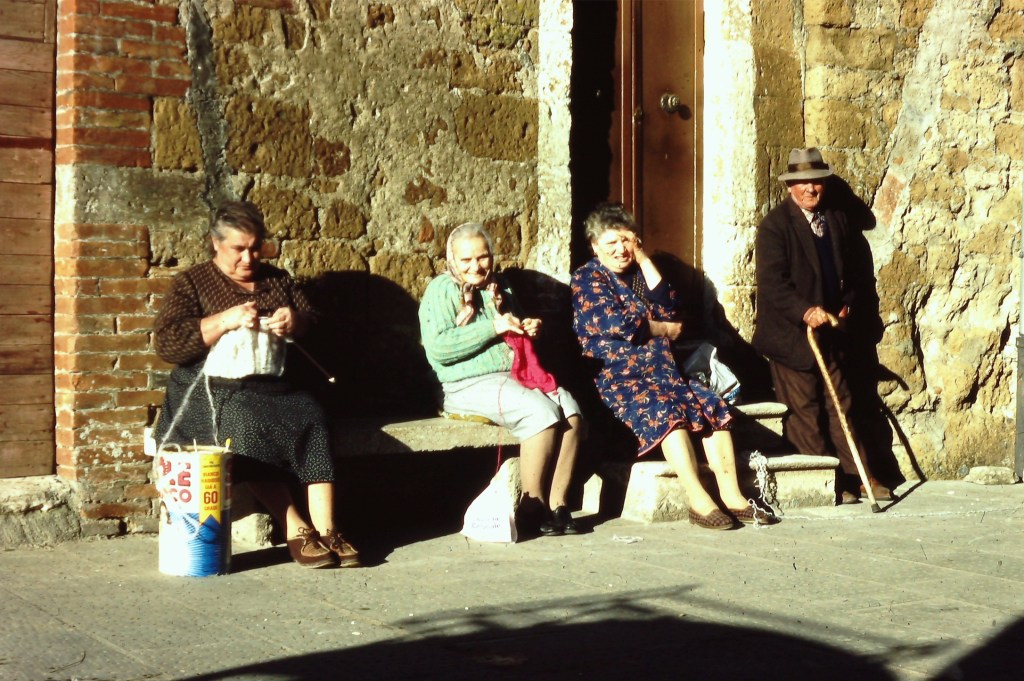
On July 13 we were back in Pitigliano for another four to five months. This included helping out with the Settimana Musicale which ran from late August until early September. Until we found regular accomodation, we camped in a tent for a few weeks on the outskirts of Pitigliano in a private garden and practised music in a nearby ancient Etruscan cave (cantina). We then stayed temporarily with kind English friends Alan and Sue in their Via Zuccharelli apartment, conveniently next to a bakery (Forno del ghetto) which made delicious breads and pastries. Eventually we took up more permanent accomodation with Nilda, a village elder, living alone, who allowed us exclusive access to an entire floor of her house in the ancient capisotto end of the village, Via Antico Pretorio, 9. Here Liz enjoyed taking a group of local shop keepers (postal workers, butchers, barber, bus driver etc) for regular English lessons.
Every morning Nilda made pastry, rolled it flat on the kitchen table with a broomstick handle, coiled it and cut tagliatelle for lunch. She pretended to not like it when Liz and I spoke English together; “Basta con quel Tisky-Tosky!” she would protest, smiling. When we left for Australia, she gave us a plastic bag full of necessary provisions to survive the journey: lollies, chocolate, bread rolls, prosciutto and cheese! She was a very sweet, lovely person.
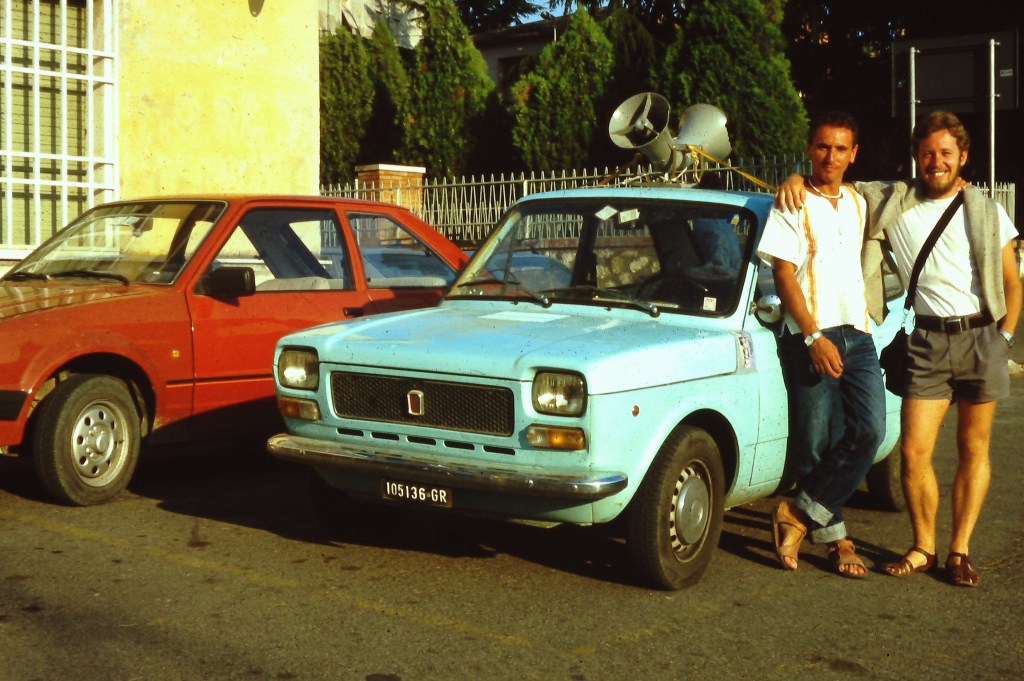
My personal highlight of the Settimana Musicale 1985, apart from the wonderful music making, was advertising the final evening concerts of the Settimane with our friend Vincenzo. He attached a large loud-speaker to the roof of his car and together we drove around Pitigliano and nearby villages (Sorano, Sovana, Manciano, San Quirico), me in the passenger seat, microphone in hand, bravely spruiking the concerts in my best and most persuasive Italian – shades of concert promotion techniques used by Jake and Elwood in the Blues Brothers movie!
Later in September, with the help of Vincenzo, we found work for many weeks as grape pickers (for the vendemmia) which saw us draw near to the end of our time in Italy.
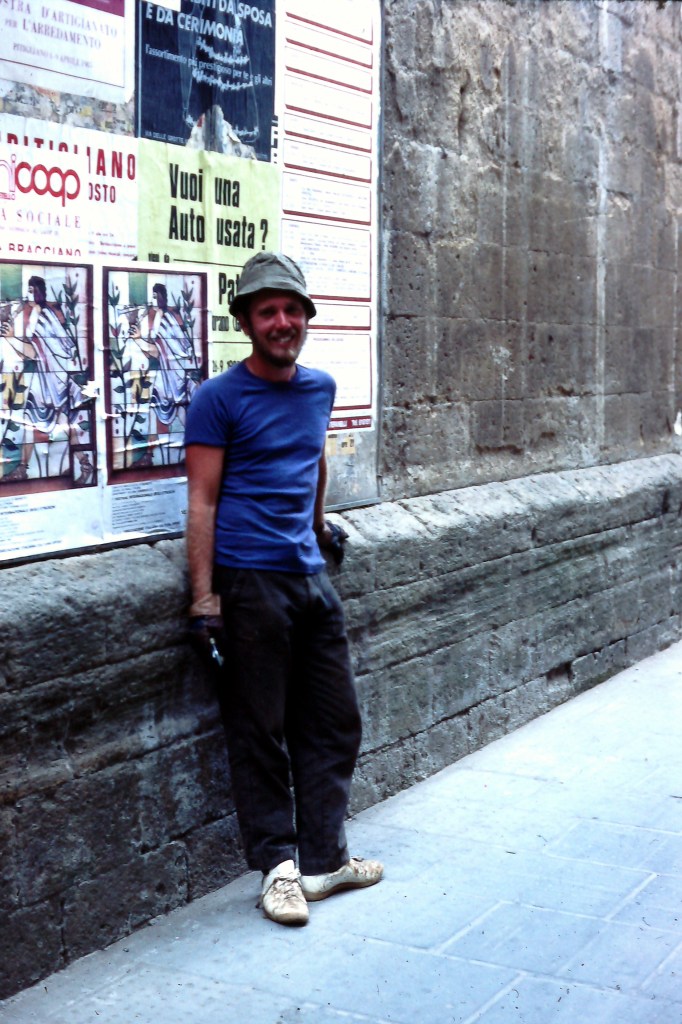
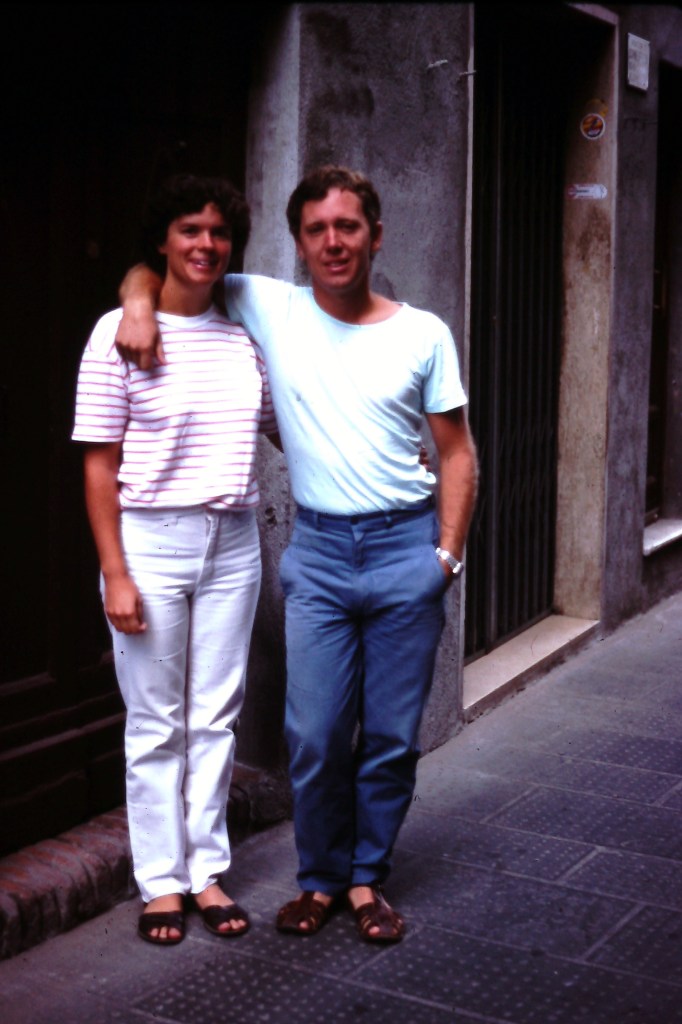
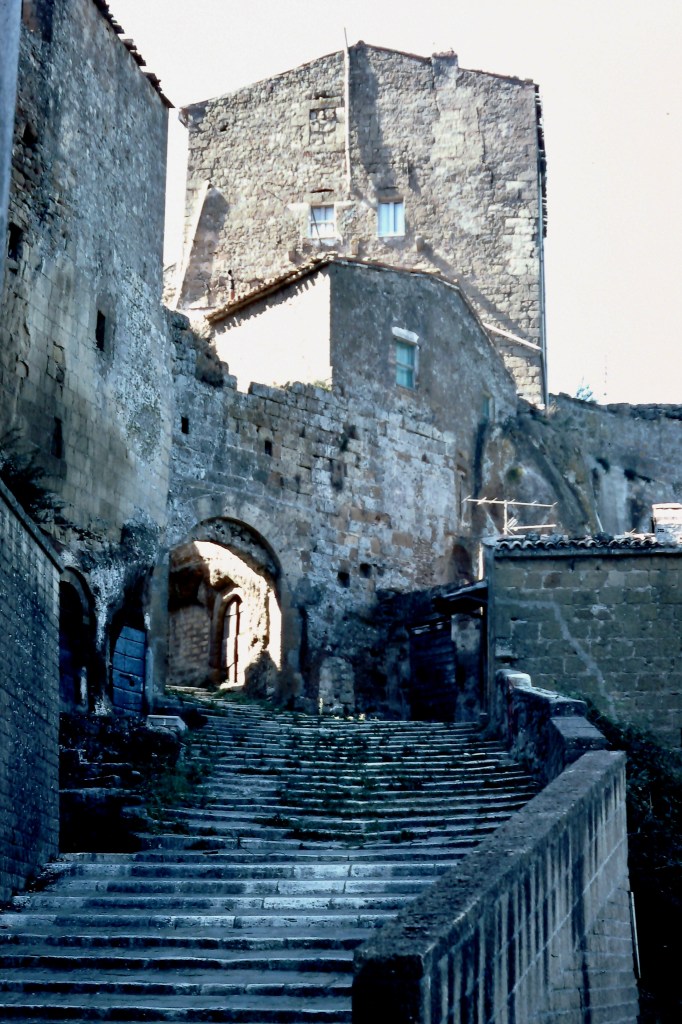
[Click on images above to see larger]
Final musical experiences in those last months ranged from giving impromptu concerts at the capisotto end of the village (the ‘other end’ of the village, where mostly older residents live) with Caroline on ‘cello, to the joyous, communal singing of workers in the fields as we all tired towards the end of a long day of grape picking. As a farewell to friends from Pitigliano, I gave a concert in the beautiful San Rocco church on the last evening, Sunday November 10, with Kees and Caroline.
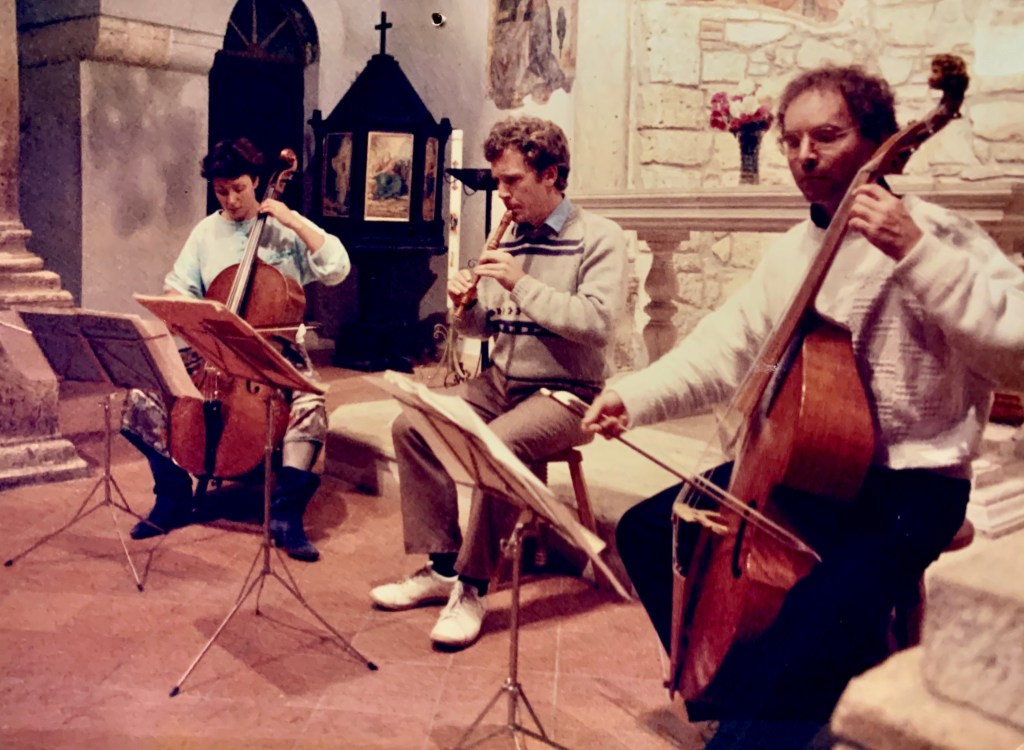
[Click on image above to see larger]
The very next morning, Monday November 11, 1985, Caroline drove Liz and I to Fiumicino Airport, Rome, and we departed for Australia. It was a fitting way to end two unforgettable years of music and adventure.
[last edited May 8, 2025]
 Rodney Waterman, Musician
Leave a comment