Sixteen Recorders At Four Relative Pitches
by Rodney Waterman ©
The original version of this article appeared in the Victorian Recorder Guild’s (VRG) Recorder and Early Music 22: 7-9 (1998)
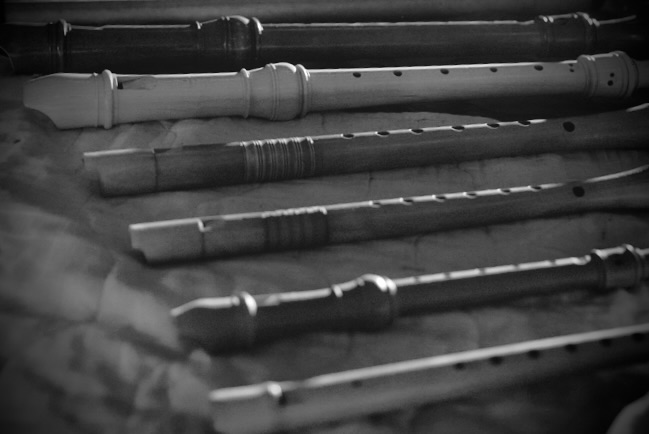
The early music revival has revitalised the way old music is performed through the use of ‘authentic’ instruments – often tuned a semitone lower than modern pitch (A440) to ‘baroque chamber pitch’ (A415) – and via historically informed performance practice. An interesting consequence of this phenomenon is that recorder (or woodwind) makers who model instruments on the design and original pitch of surviving historical instruments have inadvertently given modern players opportunities to explore a diversity of non-standard pitches relevant to, but going beyond the realms of early music.
At the Adelaide Winter School of Early Music (1996) a student performed a movement of a French baroque recorder suite at a twilight concert. I announced that he would play the piece on a French pitch (A392) voice flute (tenor recorder) in d’. I accompanied on guitar. The student played the suite movement beautifully. Was it the exquisite performance? Was it the sombre low French pitch?
Afterwards I revealed that while the student had technically performed at A392, he had actually played on a modern pitch (A440) Moeck tenor recorder in c’! If you think about it (assuming equal temperament), a tenor recorder in c’ at A440 is about equivalent in pitch to a voice flute in d’ at A392 (A392 being essentially a whole tone lower than A440 – see Table below, Recorder 15). A real eighteenth century French pitch voice flute would almost certainly have different qualities to a 20th century modern pitch tenor in c’, but it is still fascinating for players to realise how recorders take on different and unexpected roles at different relative pitches. Using the same logic, your soprano recorder in c” at A440 (Recorder 4) is also a soprano sixth flute in d” at French baroque pitch (A392).
Most of us play recorders at A440 (modern pitch) but many players now acquire ‘baroque’ recorders, especially altos in f ‘at A415 (a semitone lower than A440). Other pitches adopted by modern recorder makers (generally in semitone increments for convenience) and players include A466 (‘baroque church pitch’ – a semitone sharp of A440) and the above-mentioned ‘French baroque pitch’ of A392 (a whole tone lower than A440, and a semitone lower than A415). Some recorders are made at the specific pitches of surviving historical instruments, such as altos in f’ at A404 or A410. For a comprehensive discussion of the historical significance of pitch variation and how it relates to modern recorder playing and making, I suggest you read “A player’s guide to the recorder” by Fred Morgan (The Recorder 6: 1-4, Victorian Recorder Guild, June 1987 — reprinted in Mollenhauer’s excellent book (2007), Recorders Based On Historical Models, Fred Morgan Writings and Memories, compiled by Gisela Rothe, pp. 130-144).
How useful is this discussion to the recorder player who plays almost exclusively at A440? You can get a feel for French pitch by using your tenor in c’ (A440) as a voice flute in d’ at A392. Learn to play your tenor as though it was in d’ (d’ being the note you would normally finger as c’). One way of doing this is to pretend your tenor recorder is an alto recorder and read the treble clef as bass clef – watch out for some relative accidentals. For example, if you are playing a treble clef part written in D major, you will be actually reading in F major (bass clef) but sounding in the correct key of D major. If you are playing a treble clef part written in B minor, you will be actually reading in D minor (bass clef) but sounding at pitch in B minor. Teach this ‘trick’ to a friend and play the sublime flute duo in B minor by Hotteterre (Premiere Suite / De Pieces a deux Dessus, sans Basse Continue, Paris 1712) at something like the original pitch on your two ‘voice flutes’. If you use this technique playing an alto recorder in f’, the music will sound a minor third higher – e.g. Fantasia No.1 in A major for transverse flute solo by Telemann will sound in C major. If you use the technique to play this Fantasia in A on a voice flute in d’, it will sound in the original flute key of A major.
An alto in f’ at A415 also works well as an alto in e’ at A440 (Recorder 11). You could play the Bach flute sonata in E major (BWV 1035) on this instrument in ‘F major’ (at A415) while your accompanist plays it equivalently in E major at A440. The alto in e’ (sopranino, bass) at A440 is wonderful for building repertoire with modern guitarists. I heard a recording recently of Piers Adams playing 19th century romantic music on a sopranino in e’ at A440 (Recorder 2) with modern grand piano. In this ‘mode’, many of the sharp keys become fluently accessible without consistently tricky cross-fingerings, such as E major, A major, B minor, C sharp minor. Similarly, fourth flutes in b-flat at A415 (Recorders 6 and 16) are very useful at modern pitch (A440), as they become third flutes in a’ and A respectively; again very convenient for fully exploiting sharp keys.
Composers of course may have intended to exploit the particular tone qualities of ‘difficult’ keys. But, who really knows if Bach wrote BWV 1035 in E major because he loved the sound of that ‘sharp’ and ‘open’ key on the one-keyed flute, or whether he had other more cerebral and obtuse intentions?
Many interesting possibilities exist with the more unusual recorders. The above Bach sonata can also be played in E major at A415 by fingering the sonata in ‘F major’ on a ‘French baroque pitch’ alto in f’ at A392 (Recorder 12) while your accompanist plays in E major at A415. I know of a European player (Michael Form) who uses the alto in f’ at A392 in this way (as an alto in e’ at A415) to play the Bach flute sonata in b minor (BWV 1030) by fingering it in ‘c minor’.
The alto in e-flat’ at A415 (Recorder 13) is perhaps one of the most useful of all instruments at modern pitch – it becomes a voice flute in d’ at A440. In e-flat at A415 it is wonderful for keys flat of C major. I like to play the Bach violin sonata (BWV 1017) on this instrument (with some modifications) in the original key of c minor (fingered like d minor on an alto in f’). I think that this instrument is the most ‘perfect’ of all recorders in terms of size, weight, feel, tone quality, timbre and flexibility. It has the depth of the voice flute but the bright response of an alto. I would make it the standard recorder!
I have also used a ‘Rosenborg’ (or ‘Van Eyck’) soprano in c” at A466 (Recorder 3) as a sixth flute in d” at A415 (eg. to play N. Chedeville’s (ex-Vivaldi) Sonata no.4 in A major from Il Pastor Fido).
Australian recorder player Zana Clarke exclusively played at A466 in her duo Nardoo. She used mainly a ‘Ganassi’ recorder in g’ (A466 – Recorder 7 ) and a voice flute in d’ at A415 (which at A466 functions as a tenor in c’ – Recorder 14). Another Australian player, Racheal Cogan, exclusively played a ‘Ganassi’ in g’ at A440 (Recorder 8) when performing with the Greek music-inspired ensemble the HaBiBis.
There are many other ways that one can role play with recorders, for example, by imagining that a tenor is an alto, a voice flute or a bass – it’s all good healthy mental exercise! I sometimes imagine that my alto is a ‘cello or a trumpet for dramatic or expressive effect! Mostly however, my recorder is a recorder and I’m more than happy about that! The Table below gives some idea of the diverse possibilities for recorders relatively at four different pitches. I might add that I think a serious recorder player should be able to play in all keys on the one instrument. I point out these other possibilities in the interest of enriching the tonal flexibility and dynamic role playing possibilities of the recorder. Study the Table (below) and you might discover a few new ways of thinking about the recorder – relatively speaking!
Table
| Pitch » | A392 | A415 | A440 | A466 |
| Recorder 1 | Sopranino in g” | Sopranino in f-sharp” | Sopranino in f” | Sopranino in e” |
| Recorder 2 | Sopranino in f-sharp” | Sopranino in f” | Sopranino in e” | Sopranino in e-flat” |
| Recorder 3 | Soprano in e-flat” | Soprano in d” (sixth flute) | Soprano in c-sharp” or d-flat” | Soprano in c” “Ganassi” / “Rosenborg“ |
| Recorder 4 | Soprano in d” (sixth flute) | Soprano in c-sharp” or d-flat” | Soprano in c” “Ganassi” / “Baroque” | Soprano in b” |
| Recorder 5 | Soprano in c-sharp” or d-flat” | Soprano in c” “Ganassi” / “Baroque“ | Soprano in b” | Soprano in b-flat” |
| Recorder 6 | Soprano in b” | Soprano in b-flat” (fourth flute) | Soprano in a” (third flute) | Soprano in a-flat” |
| Recorder 7 | Alto in b-flat’ | Alto in a’ (third flute) | Alto in a-flat’ | Alto in g’ “Ganassi” |
| Recorder 8 | Alto in a’ (third flute) | Alto in a-flat’ | Alto in g’ “Ganassi“ | Alto in f-sharp’ |
| Recorder 9 | Alto in a-flat’ | Alto in g’ “Ganassi” / “Baroque“ | Alto in f-sharp’ | Alto in f’ |
| Recorder 10 | Alto in g’ | Alto in f-sharp’ | Alto in f’ | Alto in e’ |
| Recorder 11 | Alto in f-sharp’ | Alto in f’ | Alto in e’ | Alto in e-flat’ |
| Recorder 12 | Alto in f’ | Alto in e’ | Alto in e-flat’ | Voice Flute in d’ |
| Recorder 13 | Alto in e’ | Alto in e-flat’ | Voice Flute in d’ | Tenor in c-sharp’ or d-flat’ |
| Recorder 14 | Alto in e-flat’ | Voice Flute in d’ | Tenor in c-sharp or d-flat’ | Tenor in c’ |
| Recorder 15 | Voice Flute in d’ | Tenor in c-sharp’ or d-flat’ | Tenor in c’ | Tenor in b |
| Recorder 16 | Tenor in b | Tenor in b-flat (fourth flute) | Tenor in a (third flute) | Tenor in a-flat |
Table: 16 recorders each viewed at four different incremental pitches used by recorder makers and professional recorder players today. The standard pitch instruments, and the more commonly used instrument types, are indicated in bold type. The pitches A392, A415, A440 and A466 are essentially sequentially one semitone apart. Each instrument takes on a number of relatively different roles at the four specified pitches – equal temperament is assumed. Thanks to the VRG magazine editor in 1998, Greg Dikmans, for his help and guidance with this article, especially the references to instrument types and instrument pitch in the table of instruments.
21 Recorders at 5 Pitches (2007) by Charles Fischer inspired by Rodney Waterman
— Here is an expanded table by Charles Fischer with additional recorders, including the pitch A520 (published with the permission of the author):
Revised 05/09/24
 Rodney Waterman, Musician
Leave a comment